Lutheranism

Thoughts on the Feast of Pentecost

holy-spirit-window-stickerOur church, Grace Lutheran, is wonderful at educating its members on the Biblical narrative and therefore enriching our understanding of why we believe what we believe. This Sunday, our celebration of the Feast of Pentecost was another example where my faith was deepened through a clear portrayal of what occurred on the first Pentecost.

Honestly, until recently I tended to confuse the feasts of Epiphany and Pentecost. I knew one of them had to do with the outpouring of the Holy Spirit – but couldn’t clearly tell you which.

This article helped me with the basics. The word “Pentecost” is a transliteration of the Greek word pentekostos, which means “fifty”. In Jesus’ day, this word referred to a Jewish holiday that was celebrated fifty days after Passover. This day became especially significant for Christians because, seven weeks after the resurrection of Jesus, during the Jewish celebration of Shavuot/Pentecost, the Holy Spirit was poured out upon his first followers, thus empowering them for their mission and gathering them together as a church.

The biblical account of Pentecost is found in Acts, chapter 2:

When the day of Pentecost arrived, they were all together in one place. And suddenly there come from heaven a sound like a mighty rushing wind, and it filled the entire house where they were sitting. And divided tongues as of fire appeared to them and rested on each one of them. And they were all filled with the Holy Spirit and began to speak in other tongues as the Spirit gave them utterance. Acts 2: 1-4

As the multitude began to question what they were witnessing and some speculated that they were intoxicated, Peter stood up and gave a sermon, citing the prophet Joel: “And in the last days it shall be, God declares, that I will pour out my Spirit on all flesh…” (Acts 2:17). Peter goes on to make several references to David’s prophesies and reminds the crowd that they have all been witnesses to the resurrected Jesus, “who was raised by God.” Peter declares that Jesus “…being therefore exalted at the right hand of God, and having received from the Father the promise of the Holy Spirit, he has poured out this that you yourselves are seeing and hearing” (Acts 2:33).

When the multitude responded to Peter’s sermon, they asked what they should do. “And Peter said to them, “Repent and be baptized every one of you in the name of Jesus Christ for the forgiveness of your sins, and you will receive the gift of the Holy Spirit. For the promise is for you and for your children and for all who are far off, everyone whom the Lord our God calls to himself” (Acts 2:38-39).

There are many theological implications of these verses and this post isn’t going to do them justice. But, I wanted to share my personal and fairly unsophisticated thoughts on the outpouring of the Holy Spirit.

I think a lot of people, both Christians and non-Christians, sometimes feel or think that Jesus ascended into Heaven and that was it. They wonder where he is when they look around this fallen world and see all the pain and suffering. But, in fact, after Jesus was resurrected and returned to Heaven, he quickly sent his Holy Spirit to bless and empower his church.

It also occurred to me that these verses clearly describe the Lutheran (and other liturgical churches) theology of baptism. Through baptism we are imbued with the Holy Spirit and it is promised to children as well as adults. The reason Lutherans focus so intently on baptism is because that’s the event that creates Christians. When someone is baptized into the name of the Triune God, their sins are forgiven and they are given faith through grace from the Holy Spirit.

While running this afternoon, I listened to yesterday’s sermon again. Upon a second listen, I was struck by the historical aspect of these verses of scripture. Again, it occurred to me how powerful it is to believe in a faith that’s firmly rooted in the historical record. These events were witnessed and accounted to by hundreds of people. Christianity is not about believing the feelings in my heart, instead it believes in the Gospel (“good news”) that has been passed down from those who saw the resurrected Christ and received the Holy Spirit on Pentecost.

Of course, thinking more deeply about the Holy Spirit has to make one ponder the Holy Trinity. It’s awesome that God the Father begot his Son to come to earth and be the sacrifice for sinful humanity. Through the incarnation God took on human form to uphold the Law and die as a substitute for us. Then, before leaving us, Christ gave us his Holy Spirit to carry on the work of establishing God’s Kingdom. Where the Spirit is, so is the Son, and so is the Father.

Immanuel: God is with us.

Lutheranism, My Awakening

Don’t Make it Law

open bible beachMany Christians have their “go-to” Bible verses. When my anxiety started last July, I went straight to mine and held on for dear life: Trust in the Lord with all your heart, and do not lean on your own understanding. In all your ways acknowledge him, and he will make straight your paths. Proverbs 3:5-6.

I prayed this verse and tried with all of my might to feel differently- to trust God, surrender to his direction, and stop depending on myself. But, my feelings weren’t changing. I felt more and more desperate as it seemed to me that my prayers were going unanswered.

In the second week of this state, I eagerly anticipated a School Board meeting on a weekday evening. One of the board members was our Deaconess, a woman who I respect and admire immensely. She’s wise, loving, and faithful. Her counsel means so much to me. After our meeting, I asked if she had a moment to talk. After our fellow board members departed, I burst into tears and started explaining what I was going through.

Deaconess listened patiently, quietly, and with a look of concern on her face. I cannot recall everything I said (I was kind of a mess), but there were a couple exchanges I’ll always remember.

I explained that I had convinced myself that I could stay happy all the time and was now trying to reframe my understanding of happiness. I asked her how she felt about happiness. Deaconess replied, “Something happens that makes me happy, but I don’t think of happiness as a state I try to stay in.” She went on to explain that joy, peace, and hope are always present through Christ. That’s where she dwells, not in happiness or striving to feel good. This was a revelation to me.

When I told her how manically I’d been praying the Proverbs verse and desperately trying to trust, she responded, “But don’t make it law.”   She was referring to one of Luther’s revolutionary writings – the distinction between Law and Gospel in the Bible. God’s law is what humanity must fulfill whereas Gospel is what Christ has accomplished for us (therefore fulfilling the Law). Her point was clear, this verse is pure Gospel. God is inviting us to trust him, surrender to his will, acknowledge his presence, and allow him to direct our paths. It’s not a directive. It’s not “Thou shalt trust in the Lord…” All of my striving to trust was precisely opposed to the spirit of this verse. This single idea, “… don’t make it law” made the most significant impact on my growth and awakening to a life of surrender.

Towards the end of our talk, Deaconess lovingly told me that through this process, “God is deepening your peace.” At the time, I couldn’t fully embrace this idea. But, in hindsight I understand the wisdom of this observation. Through this period of suffering, God did increase my dependence on him and therefore grew and deepened my peace, (hope and joy, too!).

Several weeks later, as I was finishing my first reading of The Happiness Trap I prayed about finding a way to connect the lessons this book had taught me with my understanding of God’s plan.  From my journal that day: “I prayed aloud and asked God to help me reconcile my desire to bring Him all my worries and anxieties with these psychological practices of defusion and expansion. I felt like a linkage was missing for me and I wanted it to feel like an integrated process.”

The answer came to my mind instantly, the verse that had been in my heart and mind from the beginning – Trust in the Lord with all your heart, and do not lean on your own understanding. In all your ways acknowledge him, and he will make straight your paths. (Proverbs 3:5-6) is about surrender and acceptance of God’s superior will. Acceptance is one of the main lessons of ACT (Acceptance and Commitment Therapy). Through trusting in God, I could fully accept whatever thoughts or feelings came my way.

I had the “answer” all the time.  The process of growth has been about my ability to accept that there really isn’t anything more I need to do.  In other words, I needed to see Christ’s work in my life as Gospel instead of Law.  He’s doing all the work and I’m the grateful recipient.  I cannot control my life or improve what he has already perfected.

Lutheranism

Vocation: Life in Action

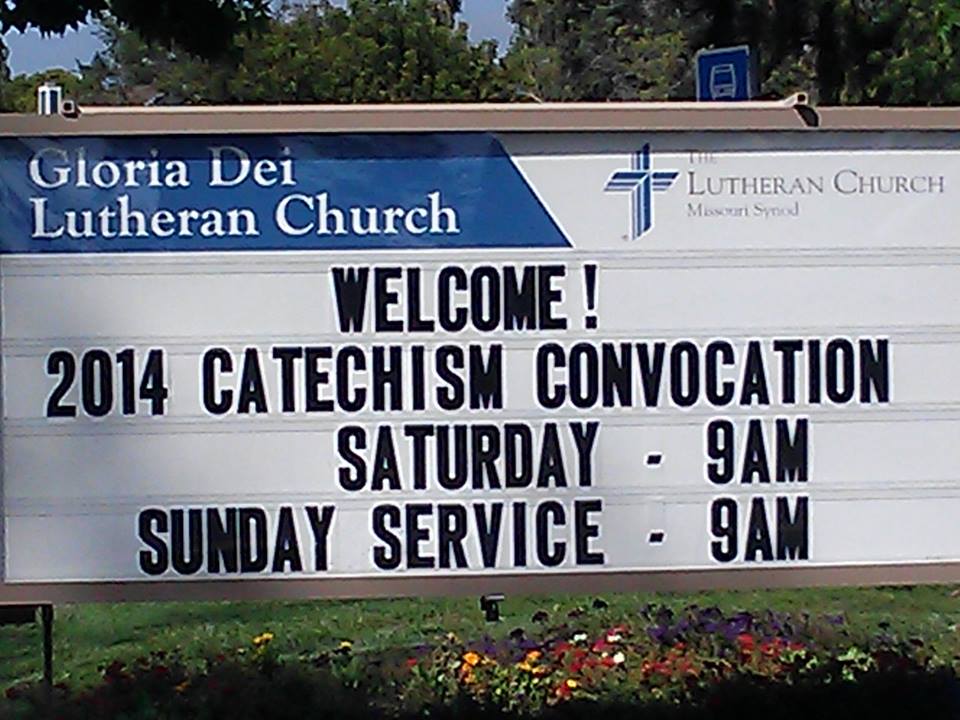
This past Saturday, Sienna and I spent the day at a Catechism Convocation for the churches of our synod in Southern California. Being relatively new to Lutheranism, I’m like a sponge, wanting to absorb as much doctrinal information as possible. Sienna was just excited to spend a day with mommy! I brought along a dozen or so Bible story coloring pages so she’d have something topical to work on while listening to several presentations that were way over her head.

convocationThis year’s convocation was entitled “The Table of Duties: Your Life in Action.” The Tables of Duties is part of Luther’s Small Catechism. It comprises duties for priests, hearers of the Word, husbands, wives, parents, children, government, employers, employees, etc. This section of the Small Catechism is related to Luther’s doctrine of vocation. As a reaction against the Roman Catholic theology that elevated individuals in the holy orders above the laity in terms of closeness to God, Luther espoused that God works through all people to fulfill their individual calling within the Kingdom.

The most important doctrine of Lutheranism is justification by faith alone. In other words, there’s nothing that we have to do in order to guarantee our salvation. Indeed, there’s nothing we could do to improve upon the complete and perfect sacrifice that Christ made for us. Luther said “God does not need your good works, but your neighbor does.” In essence, this is what our vocations are directed toward. It’s how we live and serve one another in our daily lives.

The first speaker of the day started with the simple question – is The Table of Duties a list of things we have to do in order to be good Christians? No, is the simple answer. Rather, it’s an account of how God wants us to live, presented in a way that we can easily remember. It’s not something we have to do but instead how we get to live – in the freedom that’s in Christ through his perfect grace.

sienna convoSienna and I migrated over to the youth session for the second presentation. All of the kids were at least 10 years old, most in junior high. The two pastors were very engaging and broke down vocation well for the kids. They drew a visual representation of us receiving God’s grace and love along a vertical axis and then sharing those great gifts with our neigh-bor along a horizontal axis. They cited Ephesians chapter 2:

For by grace you have been saved through faith. And this is not of your own doing; it is the gift of God, not a result of works, so that no one may boast. For we are his workman-ship, created in Christ Jesus for good works, which God prepared beforehand, that we should walk in them. Ephesians 2:8-10

We fulfill our vocations when God works through us to serve one another. We are not doing the good works, God is. We’re the instruments he uses to provide care and service to his people.
One of the youth speakers described a simple way that God provided for him that day. He announced, “While I was busy setting up for today’s event, God suddenly brought me coffee and a bagel with cream cheese!” He went on to explain that his teenage daughter (who was beaming in the audience) brought him his breakfast. The Lord worked through her to provide for her father. Pretty awesome.

This day just scratched the surface in illustrating what vocation is, but it has captured my interest and imagination. I’m eager to explore this concept more and pray that God continues to work through me to serve my neighbor and fulfill my vocation in his precious Kingdom.

Lutheranism, My Awakening

What Peace we Often Forfeit

When you stop to think about it, prayer is a pretty awesome thing.

Here we are – sinful, lowly human beings but with the ability to communicate with Almighty God, Creator of heaven and earth.   Since Jesus came to earth and reconciled humanity to God, there is a communion between God the Father, Son, and Holy Spirit and his creation. We’re able to go directly to the Lord for guidance, help, and comfort.

Isn’t it likewise amazing how often we simply opt not to take advantage of this awesome gift?

peaceI’ve thought about this often over the past nine months. As more and more answers to prayers have accumulated in my personal experience, it’s ridiculous to me that I spent so many years opting to go it alone, instead of entreating the Lord for guidance. From big things to little stresses, when I pray that God helps me to discern what I should do, change my heart about an issue, or just help me to remain calm, he is faithful each and every time.

Still, I have to remind myself to seek God’s counsel on a fairly regular basis. I suppose it’s a reflection of our fallen, self-absorbed humanity that we continue to struggle to figure things out apart from God. It’s like the ultimate example of being one’s own worst enemy.

Dennis, the kids, and I really enjoy Alan Jackson’s album Precious Memories. It’s all classic hymns in a simple country style. I love the tone of Jackson’s voice! Although there are Christian doctrinal issues that I have to overlook in some of the lyrics, the overall experience of this album is wonderful. One of my favorites is “What a Friend We Have in Jesus” – specifically for these lyrics:

What a privilege to carry everything to God in prayer!

Oh, what peace we often forfeit, Oh, what needless pain we bear,

All because we do not carry everything to God in prayer!

So true! We have access to the most awesome peace and the Lord’s supreme power to direct us, but we often choose not to abide in Him. In Paul’s letter to the Romans, he outlines the marks of the True Christian: “Do not be slothful in zeal, be fervent in spirit, serve the Lord. Rejoice in hope, be patient in tribulation, be constant in prayer.” Romans 12:11-13.

It seems that people have always needed a gentle reminder to seek God in prayer.

One of my ways of keeping this concept close to mind is through an Outlook Task reminder that pops up daily at the office. May as well use technology to help keep me focused on what’s most important! The task simply contains this verse:

“Rejoice in the Lord always; again I will say, rejoice. Let your reasonableness be known to everyone. The Lord is at hand; do not be anxious about anything, but in everything by prayer and supplication with thanksgiving let your request be made known to God. And the peace of God which surpasses all understanding, will guard your hearts and minds in Christ Jesus.” Philippians 4:4-7

Amen.

Lutheranism, My Awakening

Sentimentality and Truth

There’s an interesting paradox that’s emerged in my view of feelings and how they should influence my life. When the anxiety started last summer and I struggled to remain “happy” as I’d told myself I was and would always continue to be, getting in touch with my real emotions was a very important and necessary step. “Feeling my feelings” was my mantra for awhile.

However, as I got a grip on my anxiety and started to reflect on life, I found myself drawn to what I know to be true, namely, Christ’s sacrificial death, resurrection, and the freedom of living as a citizen of God’s Kingdom. One of the things I love about the Lutheran faith, and our congregation specifically, is the way faith and reason are united. As our Pastor once said (I’m paraphrasing):  A leap of faith is stupidity. We believe that Jesus Christ is the Son of God and that he died and rose for our salvation because of documented, verified, historical accounts in human history. Christ got out of the grave and appeared to hundreds in his resurrected state. That’s why we believe.

So, returning to feelings. Emotions are not logical or reasonable. They are simply feelings passing through our body for a certain period of time. While our emotions can tell us important things like whom and what matters to us, when we need to take action to improve situations, etc., emotions should not dictate our actions without relying upon logic and truth also.

I’m currently reading a fascinating book by Theodore Dalrymple called Spoilt Rotten: The Toxic Cult of Sentimentality. His argument is that modern society (Britain in particular, but with clear implication to America), emphasizes the importance of feelings over logic and reason, to the detriment of all. The definition of sentimentality, according to Dalrymple “is the expression of emotion without judgment.” This statement alone will cause our politically correct trained ears to pause on the word judgment because at the core of sentimentality is the cultural virtue that no one has the right to judge anything.

christChristians are told in Matthew, “Judge not, that you be not judged” (Matt. 7:1). This command speaks to the tendency of people to point out the sins of others while posing as if they are without sin. When, in actuality, we are all sinful and fall short of God’s glory. However, the current cultural virtue of not judging extends to forbidding any rational thoughts about another person’s actions or feelings. If someone expresses a feeling, it must be accepted without question.

As these ideas have been percolating in my mind this week, I realized that the elevation of feelings above logic and reason is directly related to a secular world that believes there is no truth.  As the secular world rejects the idea that human life is directed toward the ultimate goal of reconciliation with God, there is a huge void of meaning to life.  If there’s not a truth, there are infinite meanings and nothing by which to say one meaning is more true than another. When truth becomes relative, then reason and logic can easily be disregarded. What is left? Feelings. Emotions and their expression reign supreme and the individual is elevated above family, community, or (dare we say) Kingdom.

Dalrymple describes this dichotomy perfectly in another book on my to-read list: Our Culture: What’s Left of It:

“The loss of the religious understanding of the human condition—that Man is a fallen creature for whom virtue is necessary but never fully attainable—is a loss, not a gain, in true sophistication. The secular substitute—the belief in the perfection of life on earth by the endless extension of a choice of pleasures—is not merely callow by comparison but much less realistic in its understanding of human nature.”

I understand this statement to mean: when the truth of humanity’s need for a Savior to reconcile us with God’s perfect Law is rejected, society is left with the hopeless idea that life on earth is ultimate and therefore human happiness is the highest and best goal.

So, the paradox of feelings is that human beings are actually more fulfilled when they recognize the truth that their feelings are not ultimate. Lasting happiness comes from living a life of value. While I lived as if maintaining positive feelings was my ultimate goal, I struggled. Freedom and peace came when I could accept my feelings and redirect my focus on the truth that I am a sinner living in a state of grace that Christ won for all.

Lutheranism

Why I’m Lutheran

luther-seal-large

My religious experiences growing up were eclectic.

Born and raised in a progressive Catholic church, I was baptized as a baby, had my First Communion in second grade, and was confirmed in high school. However, my parents didn’t teach us many of the Catholic “rules” such as not eating meat on Fridays during Lent. Hence my embarrassment years later when I ordered a burger on Ash Wednesday amongst a group of friends at St. Mary’s College!

Along with the Catholic upbringing, my parents were also involved for many years with an ecumenical Christian retreat called Cursillo. They grew close to many families from different denominations. The impact of these retreats and the relationships with all these people of different faith traditions was that our faith became a hybrid of doctrinal beliefs.

Another factor that shaped my Christian understanding was the several years of summer camp my siblings and I attended. Instead of sending us to the Catholic camp in our county, my mom signed us up for the non-denominational Triumphant Life Camp. Our counselors came from a Baptist college in central Oregon. This was where I was introduced to praise music and was encouraged to “give my life to Christ”. Even in my early teens, this seemed a little odd since I was already baptized. My Catholic friends and I had to deal with explaining that we didn’t worship Mary and respell other misconceptions of our religion. But, it wasn’t a big deal and as kids, we just loved being at camp with our friends!

When I met my husband, we shared a religion. As co-workers, even before we starting dating, we went to an Ash Wednesday service together. We also shared similar disillusionment with the Catholic church. Although we believed in the sacraments and loved the liturgy, many of the doctrinal aspects of the Catholic Church didn’t sit well with us. I remember leaving a mass one Sunday, fairly enraged, after a long homily focusing on praying for the repose of the souls of deceased loved ones. Basically, this means we’re praying for their time in purgatory to be lessened so they can fully enjoy peace with God in heaven. Purgatory was definitely something I couldn’t embrace. Isn’t God powerful enough to purify us because of Christ’s sacrifice and our baptism into Christ’s death and resurrection? I couldn’t subscribe to the idea that God had to put people through a purification process or that we were powerful to reduce the length of that process.

Dennis and I chose not to be married in the Catholic Church. We continued to practice Catholicism during our first few years of marriage (although I later learned that we were not supposed to be taking holy communion because of our unsanctioned marriage!) – but we often talked about whether we’d actually want to have our children baptized in the Catholic Church. It had become clear to me that my major disagreement with the doctrine was the issue of salvation through grace or works. The Catholic Church holds that both grace and our works are necessary for salvation (hence the need for purgatory to finish what our good works could not accomplish). From all of my experience with protestant Christianity, I believe that God’s grace through Christ’s death and resurrection is sufficient for salvation.

When Sienna was born, we dicussed baptism with our priest.  Our choice for godmother was my sister, Sarah.  During this process, we learned that Sarah could not be Sienna’s godmother because she was married – although not married within the Catholic Church.  Apparently, our experience with a more progressive congregation growing up, meant that we’d missed the nuances of these rules.  Turns out that godparents are supposed to have all the applicable sacraments. Since she was married outside of the church, she was technically disqualified.  This was the last straw.

So, we embarked on a quest to find the right denomination for us. We knew that the liturgy and sacraments were most important, so we sought faiths that share the orthodox doctrine. For several months we attended St. Paul’s Episcopal Church near our home in Hillcrest. We met a lot of nice folks and my mom and I joined a group class on Simplicity, which was really interesting. In the end, it wasn’t the right fit for us, mostly because we found a much better one.

Sienna was about to start attending daycare so I began the hunt for a church preschool that was also a place we’d want to worship. The first and only school I visited was Grace Lutheran. It felt like coming home.

As soon as I met Pastor John, saw the beautiful sanctuary, and met the loving teachers I knew this was where we were meant to be.  We studied up a bit on Lutheran doctrine and knew, for sure, that this would be our religion. I loved the beautiful simplicity of Luther’s doctrine of justification “by grace alone through faith alone because of Christ alone”. As my understanding of Lutheran doctrine has grown, my appreciation for it has only deepened.

Given all the faiths I have been exposed to, Lutheranism feels like the perfect blend.  We have the ancient liturgy, the sacraments – where God pours out his grace for us, and the proper understanding of justification through Christ’s death and resurrection alone, without any meager attempts by me to manage my sin or improve my standing with God.

I feel richly blessed to belong to this church family.